Mobility Payments: 5 Key Concerns in the Customer Journey
Mobility payments are becoming a integral part of everyday travel, yet reliability remains a major challenge for consumers.
“44% of consumers have experienced travel disruption due to unattended payment issues”
This finding from our latest research highlights how failures in mobility payments are not just minor inconveniences – they can interrupt journeys and damage trust in the service.
As technology and consumer behaviour continue to evolve, it is increasingly important for both the payments industry and merchants to focus on the real-world customer experience and remove friction from the journey.
To better understand these challenges, Attenda commissioned independent research agency Coleman Parkes to survey 2,000 UK consumers who had made a mobility payment in the past month, uncovering key insights into how people experience payments on the move.
What are Mobility Payments?
Mobility payments are transactions that enable consumers to pay for travel-related services while on the move. This includes EV charging, fuel, parking, public transport, and micromobility services such as e-bikes and e-scooters.
As mobility services become more connected and increasingly unattended, payments play a central role in shaping the overall customer journey.
Our research shows that:
-
- Two-thirds of UK consumers make a mobility payment at least once per week
- Urban users make up to five mobility payments per week on average
At the same time, expectations are rising. Contactless cards and digital wallets are now the default, with consumers expecting fast, seamless transactions that do not interrupt their journey.
Top Concerns in Unattended Mobility Payments
1. Terminals Not Working
58% of consumers cited terminals not working as their biggest concern when making unattended mobility payments.
When a payment terminal fails, it can immediately disrupt travel plans and lead to abandoned transactions. For merchants, this not only impacts revenue but also erodes customer trust.
Terminal downtime is often linked to challenges across hardware, software, and connectivity – highlighting the need for stronger, more resilient payment infrastructure across the industry.
2. Lack of Support in Unattended Payments
39% of consumers are concerned about the lack of support when using unattended payment systems.
While many customers still value human interaction, the shift towards self-service payments continues to grow. This creates a dual challenge:
- Payments must be consistently reliable
- Support must be available when things go wrong
Reducing “payment not accepted” issues requires end-to-end resilience, including smart routing, continuous monitoring, and effective fallback mechanisms so that failures do not reach the customer.
At the same time, real-time support capabilities are essential to quickly resolve issues and minimise disruption.
3. Fines Caused by Payment Failures
Our research found that 1 in 5 consumers have received a parking fine due to a payment issue, with 38% concerned about this risk.
Unattended mobility payments often rely on stable connectivity. When network issues occur, transactions may fail without the customer realising – leading to fines or penalties later.
This creates frustration, financial inconvenience, and a negative perception of the service.
Clear payment confirmation, alerts, and support mechanisms are essential to prevent these issues.
4. Security and Fraud Risks in Mobility Payments
Nearly two-thirds of consumers have concerns about fraud when making mobility payments.
As payment technology evolves, so do fraud risks – including card skimming, cloning, contactless interception, and phishing scams linked to QR codes or digital receipts.
If a payment terminal appears unfamiliar or untrustworthy, confidence drops quickly, regardless of how secure the system actually is.
Technologies such as dual authentication and visible security measures can help reassure users, verify transactions, and reduce fraud risk.
5. Overcharging and Billing Errors
34% of consumers are concerned about overcharging or incorrect billing in mobility payments.
Many unattended payments are processed automatically, increasing the risk of pricing errors or incorrect charges. Without immediate support, resolving these issues can be difficult and time-consuming for customers.
Consumers want transparency, accurate billing, and simple ways to resolve disputes when something goes wrong.
Why Cash Is Still a Fallback for Mobility Payments?
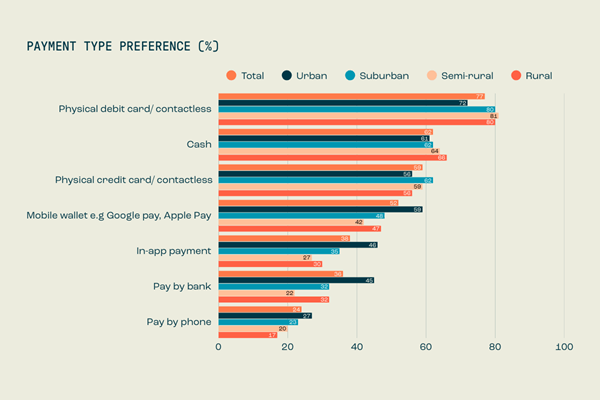
Despite the growth of digital payments, 62% of UK consumers still use cash as a fallback option.
While less convenient, cash is seen as a reliable backup when digital payment systems fail – particularly in areas with poor connectivity.
This highlights a key issue: consumers do not fully trust mobility payment systems to work every time.
How Can We Improve Mobility Payment Reliability?
From Attenda’s perspective, two priorities are critical for improving mobility payments across the industry.
Firstly, there must be a collective effort to strengthen payment infrastructure – across hardware, software, and connectivity – to increase uptime and ensure seamless transactions.
Secondly, innovation must remain focused on the customer, using data to identify friction points and applying technology to create intuitive, low-effort payment experiences.
In unattended mobility payments, success depends on consistency. If a customer cannot charge an EV, pay for parking, or start a micro-mobility journey due to a failed transaction, it does more than cause inconvenience – it disrupts the entire journey and undermines trust.
The challenge is not about introducing new payment methods, but about making existing ones work reliably in real-world conditions. Payment terminals operate 24/7, connectivity is not always stable, and there is often no on-site support.
Reducing “payment not accepted” issues requires resilience across the entire ecosystem, including intelligent routing, continuous monitoring, and effective fallback mechanisms so that individual failures do not impact the customer.
At Attenda, we take this responsibility seriously. By delivering consistent, reliable payment performance, we help create smoother journeys, build trust, and give customers the confidence to use mobility services again.
Download the Mobility Payments Report
Explore our Mind the Mobility Payments Gap report to understand mobility payments through the lens of the consumer, uncover the key friction points across EV charging, parking, and micro-mobility, and discover what the industry can do to deliver more seamless, reliable payment experiences.